For I know the plans I have for you,” declares the LORD, “plans to prosper you and not to harm you, plans to give you hope and a future. Jeremiah 29:11

Friday, October 6, 2023

                                                             Seeking the Peace of Christ 

                                Exodus 32: 1-14; John 16: 25-33

                                                                                Rev. Patrick Streeter 


As we enter into our Old Testament story, we enter into a story and really a lesson in waiting. The people had grown tired and impatient of waiting for Moses to return. Quite possibility they had lost faith during the waiting. Their impatience led them to seek a superficial means to please them. They sought a self-indulgent party. Instead of trusting God in the waiting they attempted to displace God. Let me be clear on that, they still wanted God but they weren’t willing to be patient and wait. You know, faith is often put into practice when we wait. Our faith doesn’t cost us much when things are good. But our faith does become more difficult as we face scary situations but at the heart of that, it’s the waiting that becomes most difficult. What we do while we wait reveals to us about own faith. 


In Seminary, our preaching classes taught us some basics to sermon preparation. It’s important to read and listen to the text. What was going on during that time. What’s going on before and after the text? After you understand that, you can look to, how does this text apply to us today. So a question for us this morning is this. In our waiting is God enough for us? That’s a tough question because the longer we wait, the tougher it becomes. Our situations in life, as we learn to wait, are more complex than a child waiting for Christmas Day. Our life circumstances that we face in the waiting are much harder for us to navigate. 


What does our ability to wait say about our faith? If we’re being honest with ourselves faith is easy during the good times, during the smooth sailing waters. Faith becomes more difficult when when rough waters come our way. Faith becomes more difficult in the waiting. Waiting for news. Waiting for results. Waiting for the next door to open? Waiting as we face the unknown. Waiting while enduring suffering or watching others suffer. Waiting is difficult and it is often in these moments that our faith is tested. What we do while we wait revels to us about our own faith. Let me ask you this. What do you do in the waiting? Where does your mind go? What does your heart long for? 


In our waiting we can turn to fear. There are times and seasons in our lives when we will experience fear. We will face the unknown and that will prompt fear. Fear can arise from situations in our life. Fear for the safety and health of loved ones. Fear in the midst of this political climate. Fear of terrorism in our world and our own country. We encounter fear in changing situations. Fear in the midst of divorce. Fear after separation or loss of a loved one. We have our own fears that manifest internally. The fear of being liked and accepted by our family and friends. The fear of being enough and providing enough for our family or for meeting expectations in the workplace. 


What is fear? Let me rephrase that question. Theologically, what is fear? Let me offer this to you. Fear is trusting less in God and trusting more in our own understanding. The problem with this is control. We want to control things in our lives. You may know people that seem to exhibit the need for more control in their lives and also those who seem to live more of a free spirit with the need for less control. But, at some level, we all want that sense of control. Fear can creep in when we begin to experience a loss of that control.  When we are afraid, too often instead of turning to God, we turn to what we can control and understand. When we wait, we turn to what we think we can control because waiting requires us to let go. We turn to control because  that seems safe to us.


In our waiting we can displace God and seek another need to temporarily sustain us. We can turn to superficial needs to fulfill us and sustain us. That is what happened in our story today. The people grew impatient. They wanted Moses to return immediately. We know that God is more than enough for us, but in our waiting, it can become difficult. Sometimes in our waiting we displace God and seek a placeholder to temporarily sustain us. I’m waiting for you to speak God but in the meantime, I need something to keep my focus. I’m here waiting for you but while I wait I need something else. God wants and expects our full attention and devotion. This is where faith becomes difficult but necessary. God wants us to understand that God’s plans and God’s ways are worth the wait. 


The reality in life is that we will encounter situations where we are afraid. In those situations, what do we do with our fear? What is our response? Our text in the Gospel of John provides some much needed guidance. This passage in the Gospel of John is part of the farewell discourse. The 14th through 17th chapters of the Gospel of John focus on the farewell discourse. It is the last night that Jesus is with His disciples before the crucifixion. Jesus washes the disciples feet but also offers them parting words. He is preparing them for the things that are to come. He is preparing them for the fear that will arise from the events that are about to unfold. Through this discourse we see a cycle of fear and then reassurance. Listen closely to this. Don’t miss this. Here is Jesus’ response to how we deal with fear. “ I have said this to you, so that you may have peace. In the world you face persecution. But take courage; I have conquered the world!” The response to fear in our lives is to seek the peace of Christ.  While we wait, as we experiences whatever feelings that come with the waiting, seek the peace of Christ. We must believe and hold on to the truth that the peace of Christ is greater than any fears we may encounter. 


Do you remember the story of Jesus calming the storm in the boat? Jesus and His disciples were in a boat one night when a storm came upon them. Afraid, the disciples cry out in fear, Lord, we are perishing, Save us! The response of Jesus is Peace, be still. Peace, be still.  In our seasons of waiting, seek the peace of Christ. Pray for the peace of Christ to fill your heart and enter into whatever situation you encounter. 


I don’t know where you are in this journey that we call life. I would offer these thoughts to you as I have walked through this season in my life. You are not alone. God is ever-present in our times of greatest troubles, in our moments of greatest joys and in the every day moments as we trudge through the valley’s. Waiting is the hardest thing that we must do sometimes, especially when we face the unknown. But it has been my experience that God truly does work in our waiting. 


When we find ourselves in a season of unknown. Maybe it’s a moment when everything seems to be falling away from us. Each day and each moment we continue to loose control of everything that we know and no matter how hard we hold onto it, it continues to slip away. In that season of life, as painful as it may be, our hope is Christ is more than enough to sustain us through whatever storm we face. Sometimes we have to loose what we hold dear to us, to understand that who Christ is to us is greater than anything we will ever face. 


My story is not your story. My pain is not your pain. But, we can all relate to each other on some level. And more importantly we are called to relate to each other. We are called to gather together in community. The church is needed now more than ever. You are needed more than ever. We can do more together too! We can give more. We can love more and we can share more. My father taught me that no matter what you have, no matter how little or how great, we can always give  and do more. 


Sometimes our life may feel like a fire, burning out of control. We continue to lose and there is no finish line in sight. We feel lost or out of control. Here’s the thing about fires though. Eventually they will die down. And though we may be left with ashes, we serve a God who is in the business of making beauty from ashes. That beauty will be greater than anything we may lose. Until then, keep the faith and keep seeking the peace of Christ, even in your darkest moments. Even though I don’t know your struggle or pain, know that I am on this journey too and I am praying for you. 


What are you waiting for? Maybe your season of waiting is deeper and very spiritual. Maybe you’re in a season of the in between. Maybe you’re waiting for God to guide you to what’s next. If we accept the premise of God working in our waiting, are our eyes open to the little things that God is doing in our lives in the midst of that? While we wait, God is working. God is sanctifying us. Praise be to God that no matter patient or often impatient we may be God continues to work all things for good. 

There’s a song that I love entitled Sovereign Over Us. Hear these words this morning: 


There is strength within the sorrow, There is beauty in our tears. 

You meet us in our mourning. With a love that cast out fears. 

You are working in our waiting, sanctifying us. 

And beyond our understanding, you’re teaching us to trust. 

Your plans are still to prosper, you have not forgotten us. 

You’re with us in the fire and the flood. 

Faithful forever, perfect in love, you are Sovereign over us. 


“I have told you these things so that you may have peace.” Peace, Be still”. Our response to fear must be to seek the peace of Christ. Allow the peace of Christ to enter into your heart. Allow the peace of Christ to blanket whatever situation you  may face. Allow the peace of Christ to fulfill you and to sustain you. Peace, be still! May that be enough. Amen. 


Tuesday, August 22, 2023

                                                                     Living in Unfairness

Genesis 4: 1-8; 1 Peter 3: 8-22 

Rev. Patrick Streeter


It’s not fair! I don’t understand why he get’s to do that but I don’t. Why does he get something but not me. I just want fairness. My brother is four years younger than I am. Growing up we had our fair share of arguments like any siblings do.  I can remember times growing up where my brother was given something that I wasn’t or it seemed that one or both parents favored him over me in a situation. I remember trying to make that argument that it wasn’t fair. I would try the argument that he was the favorite son because he was the youngest and he always got what he wanted. 


As I look back, a few years older, maybe a little wiser, and hopefully a little more mature, I can begin to see that the unfairness that I experienced was perceived unfairness. My parents weren’t perfect, most aren’t, but mostly they were always right. They saw the situation differently or knew something that I didn’t know and that impacted how they made decisions about their sons. My perceived unfairness was just that. In my mind, with the information I had observed and collected, the situation was unfair. I wanted fairness but what I really wanted was what I felt like I deserved. 


  Cain was hurt; the Lord had shown favor over the younger brother, Abel’s offering and he felt the unfairness come upon him. Cain was the first born, the tiller of the ground. Abel, the second and the keeper of the sheep. At some point in their life, they bring an offering to the Lord.  Cain brings forth an offering of fruit from the ground while Abel brings forth the firstlings of his flock, the fat portions. It is written that the Lord looks with favor on Abel’s offering but does not offer the same with Cain’s. Immediately Cain becomes upset and it shows. The Lord tries to warn Cain of what is right and the consequences for falling into wrong. We know how this story ends; Cain kills his brother and then must endure the consequences for his actions from the Lord. 


As we study this passage, some critics and scholars attempt to justify why the Lord favors one offering over the other. Some would say the quality of the offerings led to the Lord’s decision to regard one over the other. However, the story does not explain why the Lord favored one offering over the other. Instead, the story focuses on Cain’s reaction to the unexplained divine preference from the Lord. The point here is not to justify the perceived unfairness.  Let us not miss this important point.  When we experience unfairness in our lives, we are prone to seek justification for the unfairness. If we can only understand why or rationalize the current situation, then maybe it will be easier to understand and accept. What God is saying to Cain in this story, and to us as we experience unfairness, is that we are not to justify or rationalize why the situation is unfair. It’s not about justifying the unfairness. It’s not about why. God’s questions demonstrate that God is more displeased with Cain’s response than with the actual offering. It’s not the style of offering but the substance of Cain’s heart that is called into question. 


So Cain was very angry, and his countenance fell. The Lord said to Cain, “Why are you angry, and why has your countenance fallen?” The word countenance means, appearance, especially the look or expression of the face. Other translations say that Cain became angry and furious and his face fell or his face became downcast.  Cain experiences unfairness and becomes upset.  When life happens, when things don’t go our way, when life seems so unfair, it bothers us. It can bother us physically, emotionally and spiritually. Cain’s emotional reaction is no different than the feelings we experience when we encounter unfairness. We become upset. Being upset, feeling emotions of anger, confusion, and sadness is how we are designed responds to situations of unfairness.  But again, being upset isn’t the point here. 

If it’s not about justifying the unfairness, not about whether it’s ok to be upset when we encounter unfairness, then what? If not that, then what? It’s about how we deal with and live in the reality that unfairness happens. Bad and unfair things will happen. How we move forward and  respond makes all the difference. 


The Lord said to Cain, “If you do well, will you not be accepted? And if you do not do well, sin is lurking at the door; its desire is for you, but you must master it.” Here is God’s guidance, Gods point in this situation and God’s response to us in the midst of unfairness. In the midst of unfairness, remain faithful and trust. It may not be fair, but I am good and I am just. Don’t fall into sin that can entrap you in your quest to rationalize fairness. God’s challenge to us is to remain faithful during times of unfairness. We must recognize that we may not fully understand the circumstances, but that we are still called to trust. 


There was a season in my life when I struggled with fairness, or more so with the unfairness that I was experiencing. It seemed that everything around me was falling apart. The goodness that I was holding onto was falling apart and I just didn’t understand why. I listen to music a lot and I was going through my music at that time and started listening to some older music. As I was listening to an older band, I found myself attracted to this one song in particular. It spoke to me during this season of my life as I dealt with the questions of living in unfairness. Hear these words from this song:


Late at night I wonder why, sometimes I wonder why. Sometimes I’m so tired, I don’t even try. Seems everything around me fails, but I hold onto the promise that there is a reason.  Late at night darkness makes it hard to see, the history of the saints who have gone in front of me. Through famine, plague and disbelief, His hand was still upon them ‘cause there is a reason. 

He makes all things good, There is a time to live, a time to die, a time for wonder and to wonder why.  For the lonely nights and broken hearts, the widow’s mite in the rich man’s hand and the continent whose blood becomes a traitor. For the child afraid to close their eyes, the prayers that seem unanswered, there is a reason. 


As we struggle to understand the unfairness of life, we must remember and hold onto one thing. God is good and God makes all things good. There is a reason for all things. We may not know or understand the reason, but we do know and we must put our hope in the goodness of God. We receive and embrace this goodness through the grace of 

Christ. During our doubts, questions and suffering for doing good, for trusting, we must embrace the gift of grace. 


Peter reminds us that we may suffer for doing what is good and for doing what is right. It is by doing this that we show grace and seek the promise of hope.  Peter writes this letter to the believers living in Asia Minor as encouragement as they are enduring suffering and unfairness. Peter reminds them to remain faithful through unfairness. “Have unity of spirit, sympathy, love for one another, a tender heart and a humble mind;” this is how we are to show grace. This is how we allow others to experience grace. In the midst of unfairness, it can be easy to retaliate, to say things that we shouldn’t; easy to respond out of hurt feelings and upset hearts. Peter says this, “ For it is better to suffer for doing good, if suffering should be God’s will, than to suffer for doing evil. For Christ also suffered for sins once for all, the righteous for the unrighteous, in order to bring you to God.”  


When we begin to think about the unfairness in our lives, our suffering or the suffering of others comes into the conversation. Maybe we are in an unfair situation where we are asking how is this right, how is this fair. Maybe we are in midst of suffering seeking answers, seeking resolution. Christ suffered for us and we too will suffer. But we are called to endure that suffering. Peter also reminds us that when we suffer we are to sanctify Christ within our hearts. 


The word sanctify means to make holy, to set apart as sacred or to purify. In the midst of the questions and feelings that overwhelm us in the midst of suffering and unfairness, our hearts will hurt. Our heart will hurt because we are broken people. We must remember that we are called to sanctify our hearts with the grace of Christ. The grace of Christ is powerful enough to mend our broken and hurting hearts. 


What is our response to perceived unfairness? In the story of Cain and Abel, Cain’s response was to kill his bother. An extreme measure but that was his response to unfairness. But what about ours; How must we respond? 

Do you remember the parable of the workers in the vineyard in the Gospel of Matthew? A landowner went out early in the morning to hire laborers for his vineyard. He found some workers, agreed upon a set wage and sent them to work. Later that morning, he found some more men looking for work and hired them as well. Three more times that day he found more workers and hired them as well. When the evening came the landowner paid each of the men, beginning with last and then to the first. The workers who had worked hard all day became upset because those who had worked the least received, in their opinion, an unfair amount. 


The unfairness in life can creep into our hearts when we begin to question what we have been given or maybe not given. Maybe we work hard, struggle to make ends meet, get paid very little and we look at others who seem to work less, make more, and live a more comfortable life. Maybe our life is one hardship after another. It’s a struggle to pay the bills, we are worried about job security, we lose our job, our health or the health of those we love consumes our every moment. When the realities of life crash around us, we are left with the choice of how we will respond. Maybe our response is to live in the unfairness that is. If we must respond, then our response is through grace. 


To live in unfairness, we must live in grace. We must live with the understanding that we are unworthy, but God is worthy. We must live with the understanding that the sinless death of Christ on the cross was unfair, but necessary. We must live with the understanding that through unfairness, there is grace. The unfairness of life can wound and scar us. Where in your life have you been wounded by the hurt and pain of unfairness? Where are you still hurting? Where have you hurt others in the attempt to rationalize unfairness? Where do you need to receive grace in your life? Where are you called to extend grace to another? Live in the grace that only God can provide. During those moments when life seems unfair; when you suffer and looking for an explanation; rest in the grace through Christ. May the grace of Christ sanctify your heart. May that be enough. Amen. 

Wednesday, August 9, 2023


                                                                                The Question of “Why”

Job 38: 1-11; Mark 4: 35-41 

Rev. Patrick Streeter


My final summer of Camp Ministry was 2012. During the second week of camp, one of our 12 year old campers, named Will, collapsed during the morning assembly. He was unconscious and immediately rushed to the hospital where the surgeons worked to save his life. Will had suffered a spontaneous brain hemorrhage; an event that occurs in less than .001% of the population. The surgeons saved his life, but Will’s brain suffered traumatic injuries during the event. Following the life-saving surgery, Will spent 3 weeks in a coma and 2 months in the hospital. He was eventually released from the hospital after learning that he would have to rehabilitate his brain and body to perform nearly everything from walking to talking. Will could have died at camp. Just a few days before that day, we were on a campout. If Will had gone to sleep and this had happened, he would have died. If he would have collapsed during the campout, the likelihood that we would have been able to get him medical help in time was slim to none. Will would have died. Why? Why God would you allow this to happen to Will? Why would you put Will and his family through this? Will and has family have been good and faithful servants to you. What have they done to deserve this?

Will and his family faced a question that most of us will face at some point in our lives. The question of “Why”. Maybe it is a death or illness that hits close to home in our own lives or in the lives of the ones that we love and care for. Maybe it’s seeing the events on the news that make us ask Why. We ask; Why did God allow this? Did God allow this? If God is all good and all loving, then why would God allow such evil in the world? We ask these questions and we expect answers that are already wrapped up in a neat little bow. You may have asked those questions and heard answers such as, “It is all part of God’s plan. Trust that God knows what God is doing.” How can pain and suffering be really part of God’s plan? How can good come from that? Or maybe you have heard the answer, “Well, it is all because of free will. God allows free will, so there is evil and suffering in this world.” Try using that answer to a set of parents whose child has been born with a mental disability. It doesn’t work and it certainly doesn’t provide comfort. 

So, what’s the answer to the Why Question? What is the answer to the problem of suffering? I must be honest and up front. I don’t have the answer. And I would question anyone who says they do have the answer. I don’t think, in this life, that we will ever fully understand the Question of Why. We will never fully understand the problem of suffering. We are not privy to that information and that is the way God designed it. Do you remember in the beginning what God gave Adam and Eve? He gave them everything, but he had one request of them. That they not eat from the tree of knowledge of good and evil. Unlike God, our knowledge and wisdom are finite. We are simply not equipped to make accurate and loving judgments about good and evil. That is the way that God designed Adam and Eve and us today. We cannot fully understand good and evil and we must first come to terms with that before we can begin to understand the question of Why. 

Our understanding of good vs. evil is limited and this passage in Job reminds us of this. Do you remember the story of Job? Job was God’s good and faithful servant. God allowed Satan to test Job faithfulness to his God. This passage is where God begins to ask Job several questions about creation and good vs. evil. Job is unable to answer them. In the end, Job is satisfied with God’s response and receives everything back doubly. The point is that we can never fully understand. We can only be faithful. Maybe the heart of Job told him to trust God even when his mind could not understand the mystery of suffering. With Job, the Israelites began to see suffering of innocent people not as a punishment but as a mystery. 

Even though we cannot fully understand the problem of suffering, I do believe that there is a framework that we can develop as we begin to address the question of Why. That framework must begin with our image of God. Not only how do we view God, but how we view God in the midst of pain and suffering.

So, if we must begin with our image of God, then where do we find that image? The obvious answer would be scripture, but where do we find the image of God through scripture? The most direct image of God that we can find through scripture is found in Jesus. Jesus is our most direct, most accurate image of God. Do you remember the beginning of the Gospel of John? “In the beginning was the Word, and the Word was with God, and the Word was God. He was in the beginning with God. All things came into being through him and without him not one thing came into being. And the Word became flesh and lived among us.” Him being Jesus Christ. Jesus Christ is our image of God. If we want to know how God thinks, feels, and reacts then we must look to Christ. Christ is our God in the flesh. 

Our image of God is revealed though Jesus Christ. When we see him, we see the very heart of God. Do you remember in the Gospel of John when someone asked Jesus to show him God the Father, Jesus said, “Whoever has seen me has seen the Father.” Jesus was saying I am your picture of God. Jesus spent his ministry freeing people from evil and misery. That is what God seeks to do. What is your picture of God? What is your image of God in the midst of suffering? Your image of God in the midst of suffering may limit how you are able to view the full power of God. 

The hymn, It Is Well With My Soul, was written by Horatio Spafford. The hymn was written after several traumatic events in Spafford’s life. The first was the death of their only son who died from Scarlet Fever in 1870. In 1871 the Great Chicago Fire ruined him financially when one of his major investments burned to the ground. In 1873 the economic downturn continued to hurt him. His family had planned a trip to Europe and he had sent his family ahead because he was delayed with a business matter. While his family was crossing the Atlantic, their ship struck another vessel and sank and all four of his daughters died. His wife survived and sent word to him. As he was traveling to meet his grieving wife, he wrote the words to It is Well With My Soul. 

Spafford got it. Despite the circumstances he was in, he recognized that Jesus was in his boat and he felt the calming presence that only Christ could provide. It is well with my soul, he wrote.  No matter what comes my way, I have Christ with me. When we need Christ the most in our lives, no matter how distant he may seem, he is right there, standing with us, feeling our hurts, our pains and ready to carry the weight on his shoulders. Spafford’s prayer articulated his image of God and how that allowed him to understand his present suffering.  Our image of God can pour into our prayer life. How we pray, what we pray and when we pray can make all the difference in the midst of suffering. 

Do you remember the movie, Bruce Almighty. Jim Carey plays this career pursuing man who complains to God a lot. He misses the wonder and mystery of God. God, played by Morgan Freeman, decides to work through Bruce’s life. He does so by giving Bruce God’s powers. There is a scene you may remember where Bruce sits down one night to answer the prayers of the people. He turns on his computer where he is able to answer them in an email format. At first, he goes through them one at a time but soon becomes tired of the enormous amounts of prayers. After a few evenings of frustration he decides to select all and answer yes to everyone’s prayer. Havoc ensues and Bruce learns about the personal attention needed for each prayer and it’s consequences for each response. 

Does God always answer prayer? This seems like an important question as we continue to understand the framework of the Question of Why. How we pray, when we pray, and what we pray can indicate the answer to this question. The power and art of prayer is another sermon for another day, but there are a few thoughts that we should consider. Praying for healing, praying for a good outcome, praying for good news is a good thing. It is good because God knows what is in our hearts and wants us to voice that to God. Prayer is dependent upon the condition of our heart. We must first pray with honesty and them we must listen with an open heart and open mind. God always answers prayer, but in God’s own time, and in God’s own fashion. And we must consider that may not the answer we expect or want. Sometimes the answer may be no. That’s tough but sometimes the answer is no. Regardless of answer, God is ever-present, with us.  

God works despite the circumstances, in the midst of suffering. God is ever present; doing everything God can to draw closer to us. God continues to work to for good regardless of the circumstance. Remember the circumstances that Mark described in our Gospel reading? Jesus and his disciples were on a boat in the middle of night when a storm came upon them. Storms on the Sea of Galilee were a common occurrence. This was a bad storm and storms were a fisherman’s worst nightmare. Can you imagine being in the middle of the Sea in the dark and a storm comes upon you? Scary stuff I would imagine. Jesus was in the boat with them, asleep when the storm came upon them. Jesus was present with them. Scared and afraid they disciples awoke Jesus saying, “Teacher, do you not care that we are perishing?” How many times have we cried out the same plea? We are in the midst of suffering or the suffering and we cry out Lord, where are you? Do you not care about my suffering? Just as Jesus responds to the disciples, he also responds to us in our crisis of suffering, “Peace, be still.” In this story, we know that Jesus utters this command and the storm ceases, but I think this command is not only meant for the storms in our life, but more directly for us. When we suffer and cry out for respite from that suffering, the storm doesn’t always die down. But God always responds, and his response is one of Peace, be still. That command is meant for us. Be still and trust in me. I am here, I am present in the midst of suffering and I will give you peace to strengthen you as you endure whatever suffering may come your way. 

God is working for good in our life, despite the evil and suffering that too often creeps into our lives. God doesn’t give up. God continues to work. The story of the young man named Will is not finished. The WillPower5K was created by Will in 2013 to celebrate his recovery and help him fund his long-term rehabilitation. Now, that Will is much better, the race raises research money and awareness for HHT- the genetic condition that led Will’s brain to bleed. The first race in 2013 attracted over 1,000 runners and in 2014 the number grew to 1,200.  God has done wondrous things amidst suffering. God continued to work for good through the suffering. We must trust and move past the question of Why because God is working and eagerly wants to share that work with us. 

Beyond the Question of Why is the beauty and mystery of God’s work. Beyond the Question of Why is grace outpoured and abundant mercy. When we suffer and struggle with the Question of Why, Christ is there, with us, sharing the weight of our emotions. He is there saying, Peace, Be still! I am here and I am with you. Trust me and allow me to work through this. Regardless of the circumstances, I am greater and have come to overcome. Even on your darkest day, I am working for good because I love you. You are loved my child. May we move beyond the Question of Why. May we come to know that we love and serve a God who continues to work through our circumstances. May we listen to the voice of Christ saying, Peace, be still. May that be enough. Amen. 


Monday, June 5, 2023


In High School, I participated in choir. At the end of each school year, the choir would perform several songs at graduation. One was the Senior Song that the Seniors of the group chose to sing. My graduating class of 2007 chose "For Good" from Wicked. We had 604 students in my graduating class. For the past 10 years, I've only seen or talked to a handful of them. That's part of life isn't it? We grow up, begin the next chapter of life and friendships and relationships change. 

 The last few years have been significant in the amount of people that have come and gone in my life. Some days I reflect and I'm grateful. Thankful to have known that person and grateful for the memories. I look at a photo on my shelf or scroll through a Facebook memory and I smile because I remember a moment or a funny story. Sometimes there is sadness because that person is no longer in my life. Sadness and disappointment because I long for them in my life once again. But that's part of life isn't it?

People come and go in our lives. We drive people away, although sometimes we don't mean to. People let us down and leave us. People are taken from our lives too soon or unfairly. The person or people we long for never seem to come in our lives when we need them or want them. But that's part of life isn't it?

The reality is, it is part of life, whether we like it or not. How we deal with that reality makes all the difference. I wish I could say I've figured it out, but I haven't. When people leave, it hurts. When what we long for doesn't come to fruition, it's painful. What I do know is that there is something we can learn from people that come into our lives. No matter how long they are there for, we can and should lean into the goodness that is born from that relationship. How has that person changed us? How have we changed that person? How has that relationship made us better? 

I've heard it said, that people come into our lives, for a reason. Bringing something that we must learn. And we are led to those, who help us most to grow. If we let them, and we help them in return. 

People come into our lives and it's intentional. I really believe that Christ places people in our lives for a reason. Even though it hurts sometimes, there is something we can learn from each and every relationship. 

It well may be that we will never meet again, in this lifetime. So let me say before we part. So much of me, is made from what I learned from you. You'll be with me, like a hand print on my heart. 

Sometimes we know it's coming. We will never meet that person again in this lifetime. Maybe it's the passing of someone. Maybe it's a relationship that has come to an end. Maybe it's a friendship that has been severed and it was beyond our control. Loss and disappointment hurt. But we don't have to live in that hurt. We can let the hand print that has been left on our heart sustain us and shape us into something new. 

Who can say if I've been changed for the better. But  because I knew you, I have been changed for good. 

This comes down to us and how we see life. Is the glass half full or half empty. Do we look up to what can lift us up or do we look down and dwell in our pain and suffering. 

One of the first children I had hoped to adopt taught me a lesson that I will never forget. We'll call him Asa. Asa was 6 years old. I had had him for almost a year. The parents were not an option and DHR told me that I was going to be able to adopt him. We begin to move towards the adoption process when a relative came out of the woodwork. The relative had never taken an interest before in Asa's life and most importantly, he did not want to go with this relative. He wanted me to be his dad. DHR said it was just a formality. They had to hear the relative out  and there was NO way that he would go with the relative. 

It was the night before we went to court. The next day, the judge would decide if Asa would go with the relative. I knew the inevitable was about to happen. I was about to lose Asa. I think he knew it too, although he didn't say it. He was holding onto hope. As he got ready for bed that night, he asked if we could listen to music. He was sad. We listened to my playlist of songs that I always listen to when I am sad. At one point he asked if we could listen to the song called "Thy Will". He had a habit of getting the names of songs wrong so I thought he was confused. Little did I know that night, the song Thy Will by Hillary Scott was a song and a moment that  changed my life forever. If you are sad, in pain, lost and without a hope or understanding of what's next, this song is for you. Look that song up and you'll know what I mean. 

I miss Asa but I'm thankful he was a part of my life. The hand print he left on my heart will never go away. That's what it's about isn't it? People will come and go, but if we can have those moments that change us and shape us, can't that be enough? It has to be. In a world where people fail us, where where we fail ourselves and others, we have to hold onto something. 

Because I knew you, I have been changed for good...


Tuesday, May 19, 2020

An Anchor in the Storm


Several weeks ago I was listening to a sermon in which the pastor shared this quote. "In order to realize the worth of the anchor we need to feel the stress of the storm". Never would I have expected that less than three weeks later, I would be in the middle of not one but two of the biggest storms in my life. Life has been so difficult and almost unbearable the last two weeks beyond words. I have been sad, depressed, anxious, angry and lost with a sense of hopelessness. The challenges and struggles of my life thus far has not compared in weight to my current situation.

When we face storms in our life, when we take on the stress of those storms, our faith leads us to run towards the one who calms the storms or turn away. There is no middle ground. Someone once said our faith is like one in a boat; we are either moving towards Christ or away but never standing still. For every tear that has been shed over the last few weeks, I have searched and prayed for the anchor to hold me together in the midst of the storms. I have prayed countless nights for the peace that passes all understanding. I have prayed for hope that through this flood and fire, that Christ would be with me and never leave me alone.

I have done everything that I encourage others to do when they struggle and when they face their own storms. I have listened to my own advice. But it still hasn't been easy. I don't have all the answers and I am not the teacher when it comes to this but as the student, I would share these thoughts with you from the last couple of weeks:

1) God is good, God's ways are good and God is working all things for good. God is working in our waiting. We may not always feel this but God is working in ways beyond our own understanding.

2) Because of truth number 1, with time comes perspective and healing. We can't understand how time gives us perspective and healing until we experience it. Time is something we can't rush. In a world that has wired us to "on-demand living" the storms in our lives do not follow the same path. The more we can let go of the things that are beyond our control and focus on that which is within our control, the more we will experience a new view on our situation.

3) Take care of yourself. For me, the last few weeks has included leaning on those who love and support me in my life. For me it has meant seeking professional help. There's nothing wrong with that. Most people need to seek some sort of counseling at some point in their life. Seeking helps doesn't mean you can't handle things, it means you have the maturity to know when things are beyond your control. For me, it has also meant going away, getting out of my normal routine. For me, that's camping.

Whatever storms you may face or are currently are facing, know that you are not alone. Standing with you is a God who loves you beyond your own understanding. Peace, be still!


Monday, March 25, 2019

A call to serve

A Call To Serve..

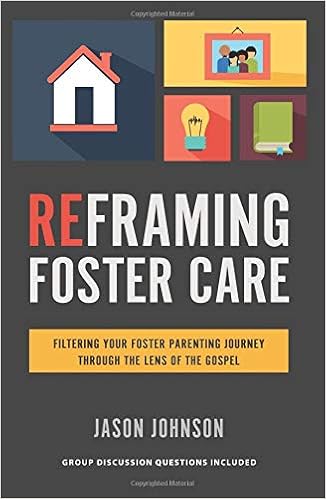
Image result for reframing foster care book

Over two years ago, I began this journey of becoming a foster parent. After two years of this journey, I have experienced some of the most life-giving and life-affirming experiences that I will cherish for lifetime. I have also experienced some of the hardest experiences that to this day, it are too painful to think about. Being a foster parent has forced me to consider what it truly means to serve and to carry the cost of following Christ. I have not always gotten it right, but I continue to do better, to learn more and to grow closer each day as I continue on the journey. I started reading this book, Reframing Foster Care, by Jason Johnson, over Spring Break. I have found so much hope and encouragement through this book as I continue on this foster care journey. But as I read through this book, my mind wandered to the bigger picture. This book is geared towards foster parents or prospective foster parents, but the application is so much greater than just them. As a Baptist minister, I see this book as clarity and direction as we all consider our call to serve the least of these. Serving the least of these takes on many forms in our lives and foster care is one of those opportunities. Over the next few weeks, I want to share some gleamings with you. My hope is that you will see a deeper picture into the life of one on the journey of Foster Care but that you will also see a connection to your call to serve Christ, in whatever context that must be.